
Discover the benefits of online learning in retirement, from languages and digital skills to cookery, bridge, book clubs and virtual cultural tours.
Since 2016, we have celebrated 15 September as National Online Learning Day, recognising the incredible learning opportunities that may be accessed from our own homes. Online learning and, indeed, internet usage really came into its own during the COVID-19 pandemic when social gatherings were restricted and we were all spending most of the time at home. The number of people in the UK studying a course online has increased year-on-year with an exceptional peak of 17% in 2019. In 2021, the language-learning app, Duolingo, recorded over 1.4 million downloads in the UK, followed by Google Classroom with 1.3 million downloads. Every year there is a rise in the number of online learners, including an increasing number of people of retirement age who appreciate that retirement can be the perfect time to learn something new and that continued learning has many benefits including improving cognitive health and reducing stress levels.
Maintaining a healthy brain
Lifelong learning has been found to improve the process of neuron regeneration and connections in the brain. Neurons, nerve cells which transmit brain impulses throughout the body, regenerate constantly to ensure the brain functions efficiently and optimally and mental stimulation improves this process.
Improving and enhancing cognitive health
Mental stimulation in the form of learning, understanding and remembering new concepts, helps sharpen memory retention skills.
Mood boosting
Taking part in cognitively stimulating activities such as learning something new can help enhance overall mood. Acquiring new skills, whether that be a new language, learning Bridge or creative writing can provide a sense of purpose and boost self-esteem.
Increasing social connection
Online learning by taking an online course with other people or by joining an online reading group or creative writing group can help social interaction and help reduce
A source of enjoyment
Taking on new challenges, taking online tours of the world’s finest museums, learning new skills, learning a new language can all be satisfying and extremely enjoyable.
Tips for studying online
What can I learn or participate in online?
There are so many online courses and informative online tours available that the difficulty is knowing which to choose. Here, we offer just a few of the most popular.
You might want to study a degree with the Open University but, if you just want to engage with something new and interesting, the OU runs free, online short courses called OpenLearn. Take a look at www.open.edu/openlearn/about-openlearn/try.
These are free and available immediately; you can start right away or at a time that suits you and work through at your own pace. There are around 1,000 courses to choose from, always focusing on a specific area of learning. Courses include Ageism and age discrimination, a Society, Politics & Law, Level 1 course which spans 3 hours. Start Writing Fiction is one of the many creative writing courses in the History & The Arts section. Introduction to cyber security and staying safe online is an extremely useful course in the Digital & Computing section.
One of the joys of the internet is that you can travel to new cities, new countries and cultural centres without ever leaving your living room.
Take a look at www.worldvirtualtours.online and book yourself on one of their live tours. These are free, live, online cultural programmes for anyone interest in history, archaeology, art history and world heritage. Sessions combine expert lectures with immersive visual experiences with the live walking tours broadcast directly from historic cities and archaeological sites. Programmes are led by professional guides and experts and include a live Q and A session. Think about exploring Medieval Winchester, learning about ‘Van Gogh – The Art and The Man’ or touring the Uffizi Gallery in Florence.
Visit www.roadscholar.org/travel-tips/lifelong-learning-for-seniors/#online-travel and you’ll be able to join one of Road Scholar’s experts to learn about such topics as early Viking settlements in Norther France and the evolution of Native American cuisine in New Mexico during 45-minute live on-line event including a 30-minute lecture and a 15-minute interactive Q & A session.
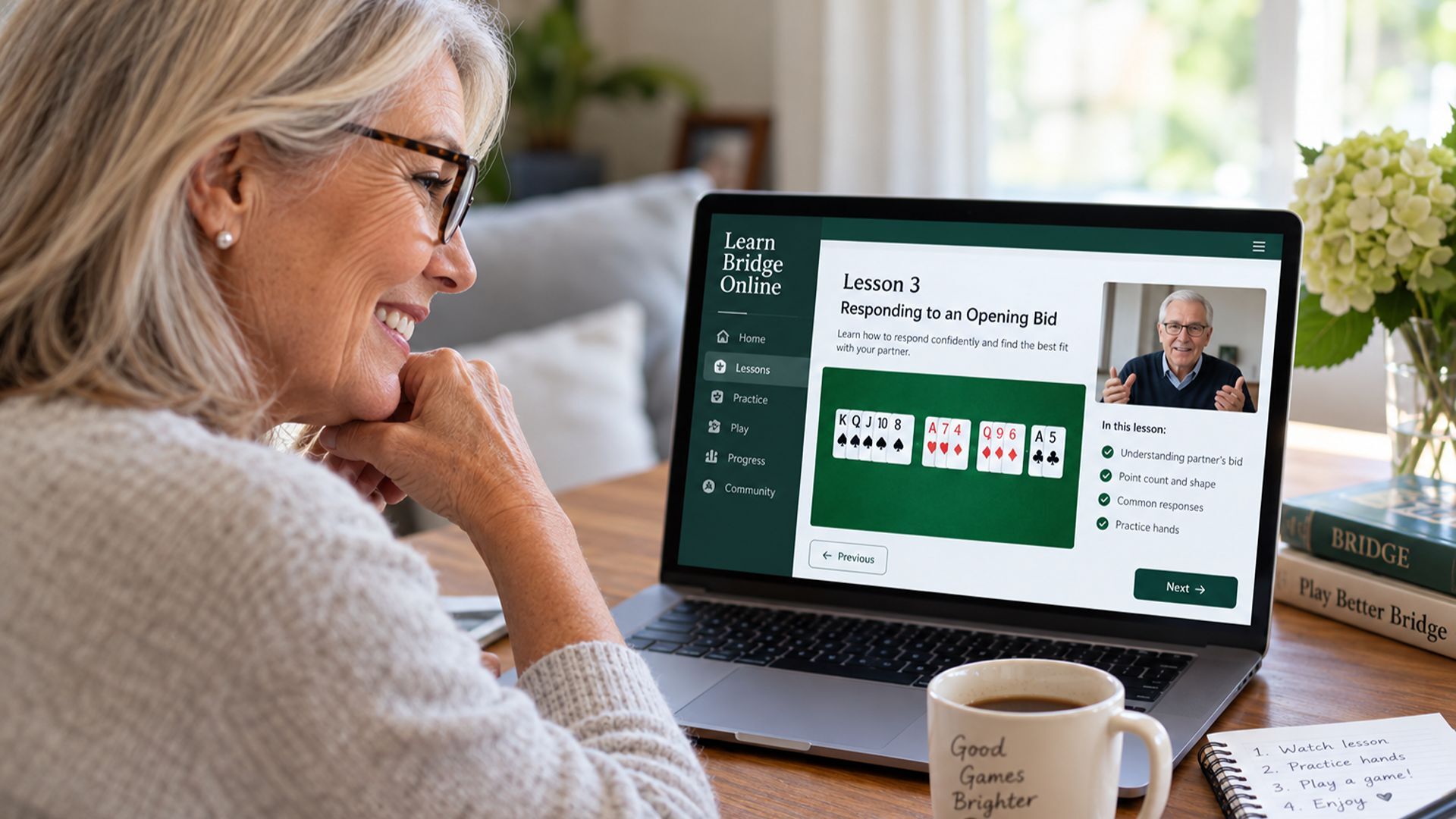
If you want to learn bridge online with the best teachers from around the world there are many different bridge lessons online, some free and some that require a subscription.
Joining www.learnbridgeonline.com as a member, you’ll be able to have a new online bridge lesson every week, live or on replay, ask your teacher questions on the class page, explore the library of recorded bridge lessons and have free and discounted member events and play session.
Free lessons are available from www.60secondbridge.com. These are short lessons finished in minutes which encourage you to practise straight away. Free to start and no account necessary.
If you want to hone your culinary skills or learn more about gastronomy, there’s a fantastic selection of online courses.
If you’re interested in gastronomy, one of the free courses is www.alison.com/course/introduction-to-cooking-and-gastronomy which explains gastronomic concepts, outlines methods for preserving and processing meat and fish and explains the difference between food allergy and food intolerance and lots more.
The Delia Online Cookery School promises to teach you to cook with confidence. This is a course full of recipes, essential cooking techniques and step by step lessons designed for anyone who wants to cook from scratch or hone their skills. There are five structured terms including mastering classic baking recipes, learning how to create delicious cakes, scones, muffins, biscuits and rich chocolate cakes. There are also sauce-making techniques, a lesson dedicated to batters, the techniques for creating light, buttery pastry, home-made bread and cooking rice and pasta. Each lesson has an easy-to-follow video allowing you to cook alongside Delia at your own pace.
There are so many language courses available online but the top learning platforms in the UK include Duolingo, Rosetta Stone, Babbel, Coursera, FluentU and italki Some of these provide free courses and some require payment or subscription.
There are many different types of IT and computing courses available online but if you’re retired and just want to learn more or hone your skills, the following are all free courses. If you’re an advanced IT user, it’s worth looking at the OU short OpenLearn courses.
Online book clubs are an excellent way to connect with other book lovers and to read, connect, discuss and explore books with communities across the world. They offer a chance to engage with readers from different backgrounds and culture and motivate you to read books you might otherwise have overlooked.
30 June 2026
Discover five great reasons to retire to Chinnor, from its friendly community and local amenities to scenic Chiltern Hills countryside,…
Read more25 June 2026
Step back in time on the Chinnor & Princes Risborough Railway, with steam and diesel train rides, Chiltern views, themed events,…
Read more2 June 2026
Living in Binfield, an area known for its woodlands and meadows, means having access to some beautiful walks, peaceful parks, green,…
Read more